
This white paper addresses the following openfunds fields
OFST005010 Has Umbrella
OFST005010 Umbrella
OFST010020 Legal Fund Name Including Umbrella
OFST010110 Legal Fund Name Only
OFST020050 Share Class Extension
OFST020060 Full Share Class Name
OFST020070 Abbreviated Share Class Name
Function of a fund name
A fund name serves several purposes depending on the perspective. In the eyes of investors and fund regulators, a fund name should reveal information about the investments contained within the fund, as well as the investment objectives. From the fund providers’ viewpoint, the name should attract attention to the fund while supporting the fund provider’s marketing goals. In case the fund is targeting sustainability criteria, it has to adhere to ESMA’s guidelines on funds’ names using ESG or sustainability-related terms. Last but not least, the fund name should serve the purpose of clear identification. It should be sufficiently unique as to avoid confusion with funds offered by other providers, as well as with other funds offered by the same provider.
In addition to these three main naming objectives, another criterion is often imposed by financial services providers, print or electronic publication platforms; harmonisation of fund names across fund ranges from different Asset Managers. As distributors of fund information strive to improve the readability and usability of their medium, they regularly shorten and group fund names from all fund providers according to stringent rules. As these changes result in a change in the field’s content, openfunds addresses this issue by labelling these fields “hybrid fields” (see white paper “Field Typology“).
Umbrella structures and stand-alone Funds
In many countries, a fund may be established either as an umbrella fund or as a stand-alone fund.
An umbrella fund usually contains multiple sub-funds. Unfortunately the term “fund” can be ambiguous, as it is used either for the umbrella (multi-fund) construction, or for individual sub-funds belonging to an umbrella structure. The usual naming convention depends heavily on the jurisdiction; in Luxembourg, umbrella structures are referred to as “funds”, whereas in German-speaking countries, this term tends to refer to the individual sub-funds or to funds without an umbrella (“stand-alone funds”). The following table shows the most commonly used terms:
| Level | Umbrella funds (structure with multiple funds) | Stand-alone funds (Single fund construction) |
|---|---|---|
| 1. Umbrella | Umbrella Fund (LU, UK, IE, FR) Umbrella-Konstruktion (DE) Umbrella-Fonds (DE, CH) Umbrella-Struktur (LI) OPCVM à compartiments (FR) Commonly used terminology: Umbrella, Fund, Fonds |
— |
| 2. Subfund | Subfund (LU, UK, IE) Sub-Fonds (DE) Compartiment (FR, LU) Teilvermögen (CH) Teilfonds (DE, LI) Commonly used terminology: Fund, Subfunds | Stand-alone Fund (UK, IE) Investmentfonds (DE, LI) Anlagefonds (CH) Commonly used terminology: Fund, Einzelfonds |
| 3. Share class | Share Class (LU, UK, IE) Anteilsklasse (DE, CH) Tranche (CH) | Share Class (LU, UK, IE) Anteilsklasse (DE, CH) Tranche (CH) |
Complexity and confusion arise, as the term „Fund“ is frequently used at Level 1 (Umbrella level) as well as at Level 2 (Sub-fund level).
Database design
Since an Umbrella structure may consist of multiple sub-funds, and a sub-fund may consist of multiple share classes, there can be a 1:n relationship between umbrella structure and sub-funds, and the same relationship can exist between sub-funds and share classes.
To avoid redundancies in the three levels, often only the distinguishing components of the respective fund names are stored (efficient databases design). This convention contradicts the fund identification function mentioned above, as this can only be fulfilled when all three fields are populated and transmitted. For practical reasons, on the international level these three fields form a “unique key” that may even require a fourth field “Domicile”, to distinguish between funds with identical names that are offered from different countries.
Approach in openfunds
To fulfil all the above mentioned requirements with as few fields as possible, openfunds implements seven fields illustrated in the below. The field in the first row, OFST005010 “Has Umbrella”, clarifies if the instrument is part of an umbrella structure or not (stand-alone fund). Only if it is set to “yes”, information in OFST005010 “Umbrella“ is expected; if it is set to “no”, OFST005010 “Umbrella“ must be blank.
The fields in the first four rows (OFST005010 “Has Umbrella”, OFST005010 “Umbrella“, OFST010110 “Legal Fund Name Only“ and OFST020050 “Share Class Extension“) fulfil the criteria for efficient database design. The fields OFST010020 “Legal Fund Name Including Umbrella“ and OFST020060 “Full Share Class Name” in rows five and six could serve for practical identification of the fund or the share class.
A detailed description of each field is directly linked to in the field name, or can be found in the current openfunds fields list.
| Nr. | openfunds field | Level | Hybrid? |
|---|---|---|---|
| 1 | OFST005010 Has Umbrella | 1 (Umbrella) | No |
| 2 | OFST005010 Umbrella | 1 (Umbrella) | No |
| 3 | OFST010110 Legal Fund Name Only | 2 (Subfund | No |
| 4 | OFST020050 Share Class Extension | 3. Share Class | No |
| 5 | OFST010020 Legal Fund Name Including Umbrella | 1 and 2 | No |
| 6 | OFST020060 Full Share Class Name | (1), 2 and 3 | Yes |
| 7 | OFST020070 Abbreviated Share Class Name | (1), 2 and 3 | Yes |
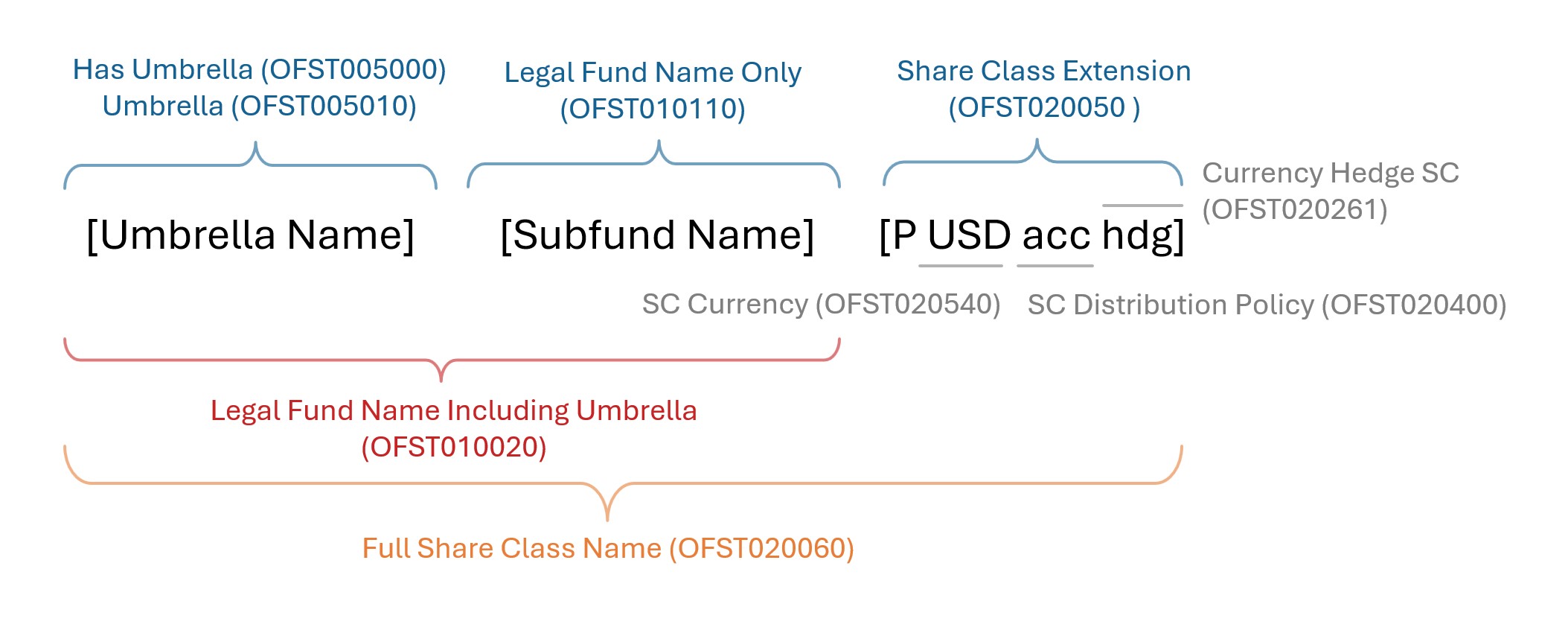
OFST010020 “Legal Fund Name Including Umbrella“
The value of OFST010020 “Legal Fund Name Including Umbrella“ can be constructed simply by concatenating OFST005010 “Umbrella“ and OFST010110 “Legal Fund Name Only“. To allow the reverse (de-constructing OFST010020 “Legal Fund Name Including Umbrella“ into Umbrella and Legal Fund Name), a clearly defined character string delimiter is required to separate the two components. For this reason, openfunds has proposed the empty space character (ASCII-code 32) followed by a hyphen (ASCII-code 45) followed by empty space character (ASCII-code 32) to separate the two components.
Where the umbrella name is already incorporated into the legal sub-fund name as defined in the fund prospectus, it is advisable to omit any additional repetition in order to prevent overly long fund names and to ensure clarity and readability. (see also Table 4, row 5 in the section below).
Examples
In the following examples, four funds, one umbrella with two subfunds, another umbrella with one subfund and one stand-alone fund, are shown in a typical operational data template.
Table 3 lists the three complementary fields OFST005010 “Umbrella“,OFST010110 “Legal Fund Name Only“ and OFST020050 “Share Class Extension“, plus the additional Boolean field OFST005000 “Has Umbrella”.
| Nr. | OFST005000 Has Umbrella | OFST005010 Umbrella | OFST010110 Legal Fund Name Only | OFST020050 Share Class Extension |
|---|---|---|---|---|
| 1 | yes | Wellington Management Funds (Ireland) plc | Wellington Focused European Equity Fund | USD D AccH |
| 2 | yes | Wellington Management Funds (Ireland) plc | Wellington Focused European Equity Fund | GBP N AccU |
| 3 | yes | Wellington Management Funds (Ireland) plc | Wellington Global Stewards Fund | EUR DL AccH |
| 4 | yes | Wellington Management Funds (Ireland) plc | Wellington Global Stewards Fund | USD M AccU |
| 5 | yes | UBS (Lux) Equity SICAV | UBS (Lux) Equity SICAV – European Income Opportunity (EUR) | (CHF hedged) P-acc |
| 6 | no | – | Edmond de Rothschild Credit Very Short Term | A |
| 7 | no | – | Edmond de Rothschild Credit Very Short Term | B |
Row numbers 1 to 4 in Table 3 correspond to an umbrella fund which has two sub-funds, each containing two share classes. Row 5 shows an example where the Umbrella is also part of the “Legal Fund Name Only”. Rows 6 and 7 correspond to a standalone fund containing two share classes.
Table 4 below presents the same funds; however, in this case the fund names are displayed as they appear in the openfunds field OFST010020 “Legal Fund Name Including Umbrella”. It should be noted that in rows 1 to 4 the umbrella name is followed by the sub-fund name. In row 5, as the umbrella name is already contained in the legal fund name, it does not need to be added again. In rows 6 and 7, only the fund name is provided.
| Nr. | OFST010020 Legal Fund Name Including Umbrella | OFST020050 Share Class Extension |
|---|---|---|
| 1 | Wellington Management Funds (Ireland) plc – Wellington Focused European Equity Fund | USD D AccH |
| 2 | Wellington Management Funds (Ireland) plc – Wellington Focused European Equity Fund | GBP N AccU |
| 3 | Wellington Management Funds (Ireland) plc – Wellington Global Stewards Fund | EUR DL AccH |
| 4 | Wellington Management Funds (Ireland) plc – Wellington Global Stewards Fund | USD M AccU |
| 5 | UBS (Lux) Equity SICAV – European Income Opportunity (EUR) | (CHF hedged) P-acc |
| 6 | Edmond de Rothschild Credit Very Short Term | A |
| 7 | Edmond de Rothschild Credit Very Short Term | B |
Table 5 shows the same funds again, however this time with the full name in the openfunds field “OFST020060 Full Share Class Name”:
| Nr. | OFST020060 Full Share Class Name |
|---|---|
| 1 | Wellington Management Funds (Ireland) plc – Wellington Focused European Equity Fund USD D AccH |
| 2 | Wellington Management Funds (Ireland) plc – Wellington Focused European Equity Fund GBP N AccU |
| 3 | Wellington Management Funds (Ireland) plc – Wellington Global Stewards Fund EUR DL AccH |
| 4 | Wellington Management Funds (Ireland) plc – Wellington Global Stewards Fund USD M AccU |
| 5 | UBS (Lux) Equity SICAV – European Income Opportunity (EUR) (CHF hedged) P-acc |
| 6 | Edmond de Rothschild Credit Very Short Term A |
| 7 | Edmond de Rothschild Credit Very Short Term A |
Ultimately the field OFST020060 “Full Share Class Name” comprises the two concatenated fields OFST010020 “Legal Fund Name Including Umbrella” and OFST020050 “Share Class Extension”.
The field OFST020060 “Full Share Class Name” lists all three components of a fund’s name, making it the most comprehensive field for identifying a share class, particularly in cases where no ISIN is available. However, this field cannot be reliably and uniquely deconstructed into its three constituent elements – “Umbrella”, “Sub-fund”, and “Share Class”. This is demonstrated by the first three funds in Table 5, where it is not unequivocally clear whether the currency (USD, GBP, EUR, etc.) pertains to the fund/sub-fund level or forms part of the Share Class Extension. A similar issue arises in row 5: although omitting the umbrella name is correct, this omission nonetheless prevents a proper deconstruction of the full name into its three components.
For this reason, openfunds recommends transmitting the data of all three levels. This can be done either by sending all the three complementary fields separately (OFST005010 “Umbrella”, OFST010110 “Legal Fund Name Only“ and OFST020050 “Share Class Extension“), or by transmitting the field OFST010020 “Legal Fund Name Including Umbrella” plus the field OFST020050 “Share Class Extension”. It is not recommended to send only the field OFST020060 “Full Share Class Name”, as the content of this field cannot be uniquely deconstructed into the three levels mentioned above.
Document information
| Title: | Fund Names |
| Language: | English |
| Confidentiality: | Public |
| Author(s): | openfunds |
Revision History
| Version | Date | Status | Notice |
|---|---|---|---|
| 1.3 | 2025-11-25 | Final | General update to capture also the use case where the umbrella name is repeated as part of the subfund name. |
| 1.2 | 2016-05-18 | Final | Corrected OF-ID for “OFST010020 Legal Fund Name Including Umbrella”. |
| 1.1 | 2016-05-12 | Final | Minor corrections in English version. |
| 1.0 | 2016-04-08 | Draft | First Version. |
Implementation
If you have any questions about the new data type or difficulties with implementation please contact us at businessoffice@openfunds.org.
Joining openfunds
If your firm has a need to reliably send or receive fund data, you are more than welcome to use the openfunds fields and definitions free-of-charge. Interested parties can contact the openfunds association by sending an email to: businessoffice@openfunds.org.
openfunds.org
c/o Balmer-Etienne AG
Bederstrasse 66
CH-8002 Zurich
Tel.: +41 44 286 80 20
Email: businessoffice@openfunds.org
If you wish to read or download this white paper as PDF, please click here.