
This white paper addresses the following openfunds fields:
Subscription related fields
OFST405521 Subscription Trade Cycle Period
OFST405523 Number Of Possible Subscriptions Within Period
OFST405525 Weekly Subscription Dealing Days
OFST405526 Monthly Subscription Dealing Days
OFST405528 Yearly Subscription Dealing Days
OFST405530 Dealing Days Of Multiple Subscription Trade Cycles
OFST405532 Irregular Subscription Dealing Days
Redemption related fields
OFST425561 Redemption Trade Cycle Period
OFST425563 Number Of Possible Redemptions Within Period
OFST425565 Weekly Redemption Dealing Days
OFST425566 Monthly Redemption Dealing Days
OFST425568 Yearly Redemption Dealing Days
OFST425570 Dealing Days Of Multiple Redemption Trade Cycles
OFST425572 Irregular Redemption Dealing Days
Trade cycle definition and practical issues
The majority of funds can be issued (bought) and redeemed (sold) directly with fund houses on a daily basis. This is what we call a ‘daily trade cycle’. Besides this, however, there are other possibilities, for example trading a fund once a week, twice a month or several times during the year. As the fund houses try to match their fund’s asset liquidity to their investor’s liquidity requests, they sometimes use a combination of several trade cycles. Examples for trade cycles are ‘every last business day of February, May, August and November’ or ‘each Wednesday plus every last business day of the month’.
When it comes to data processing, this can be complex, especially if you want to validate this data during transmission. This is why openfunds suggests a system that can handle most of the possibilities relatively easily but also reflects complex trade cycles.
Concept
The main concept consists of three components (= parts), which are:
- the ‘Period’,
- the number of trades within this period, called the ‘Frequency’ and
- the ‘In Frequency’, meaning all specific dealing days
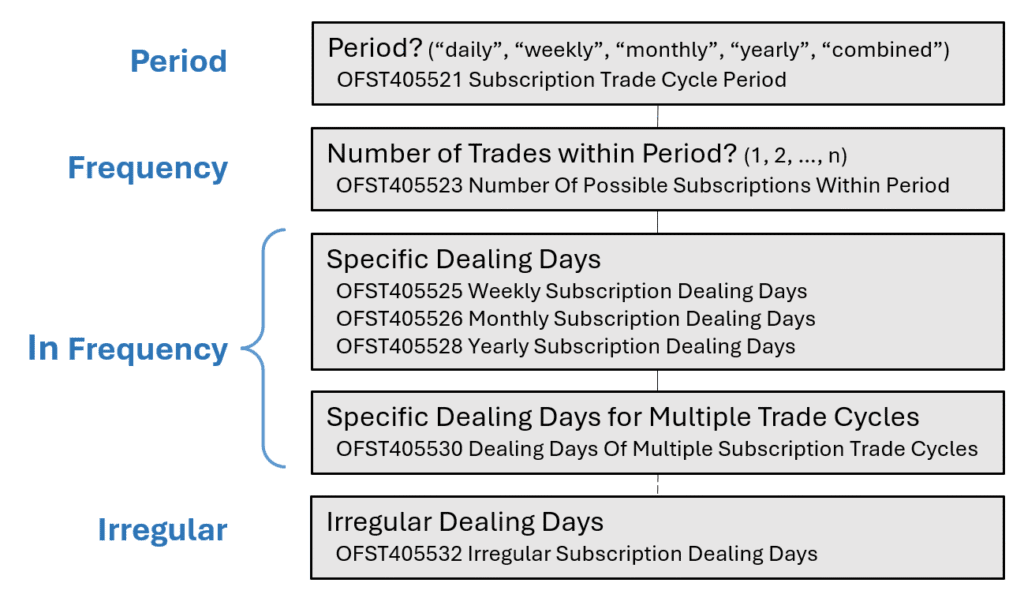
All three parts are outlined in blue in the two charts in Table 1 below, where the first chart shows all relevant fields for subscriptions and the second chart shows the relevant fields for redemptions.
Trade cycle for subscriptions
Trade cycle for redemptions
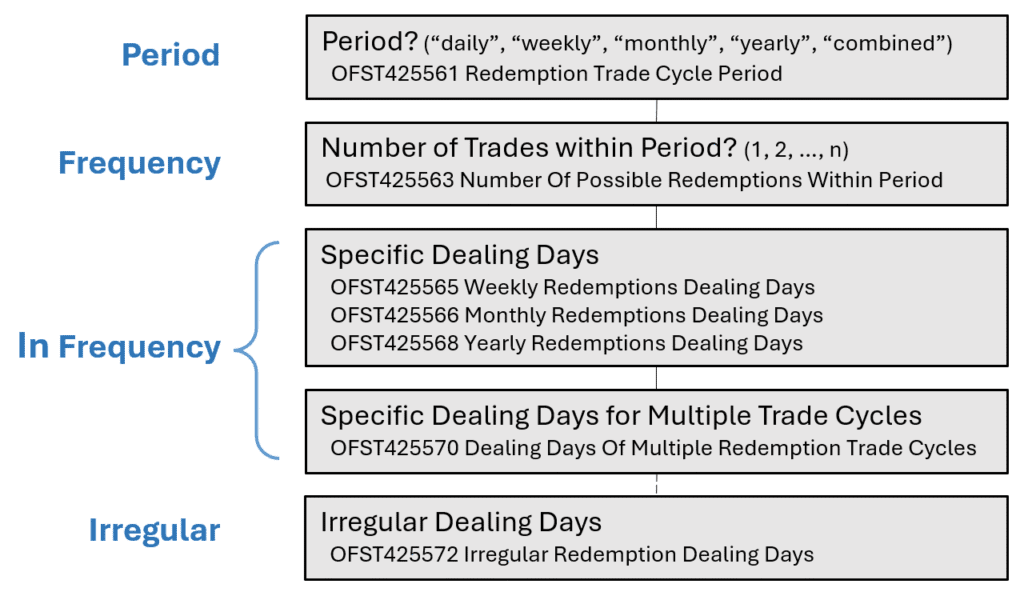
Table 1: Concept for subscription and redemption trade cycles
openfunds specifies the parameters for funds with only one trade cycle with fields belonging to the three above-mentioned layers (‘Period’, ‘Frequency’ and ‘In Frequency’).
For funds with more than one trade cycle, you should specify these cycles within the specific fields related to that use case (“Specific Dealing Days for Multiple Trade Cycles”).
If the fields from the three layers do not cover a specific case, e.g. ‘6th last business day’, there are two additional fields for irregular dealing days. One is for subscriptions (OFST405532) and one for redemptions (OFST425572). These are free format text fields and allow to input irregular dealing days. However, most cases can be handled with fields from the three ‘regular’ layers.
The openfunds approach
Funds with daily trade cycle
Most traditional open-ended funds have daily trade cycles. Therefore, this is mentioned separately here so you may skip the following paragraphs if this is all you are concerned with. A daily trade cycle is, however, captured the same way as all other periods explained below.
For a daily trade cycle please put “daily” into OST405521 “Subscription Trade Cycle Period” for subscriptions or into OFST425561 “Redemption Trade Cycle Period” for redemptions. The ‘Frequency’ fields (OFST405523 “Number Of Possible Subscriptions Within Period” or OFST425563 “Number Of Possible Redemptions Within Period”) default to “1”.
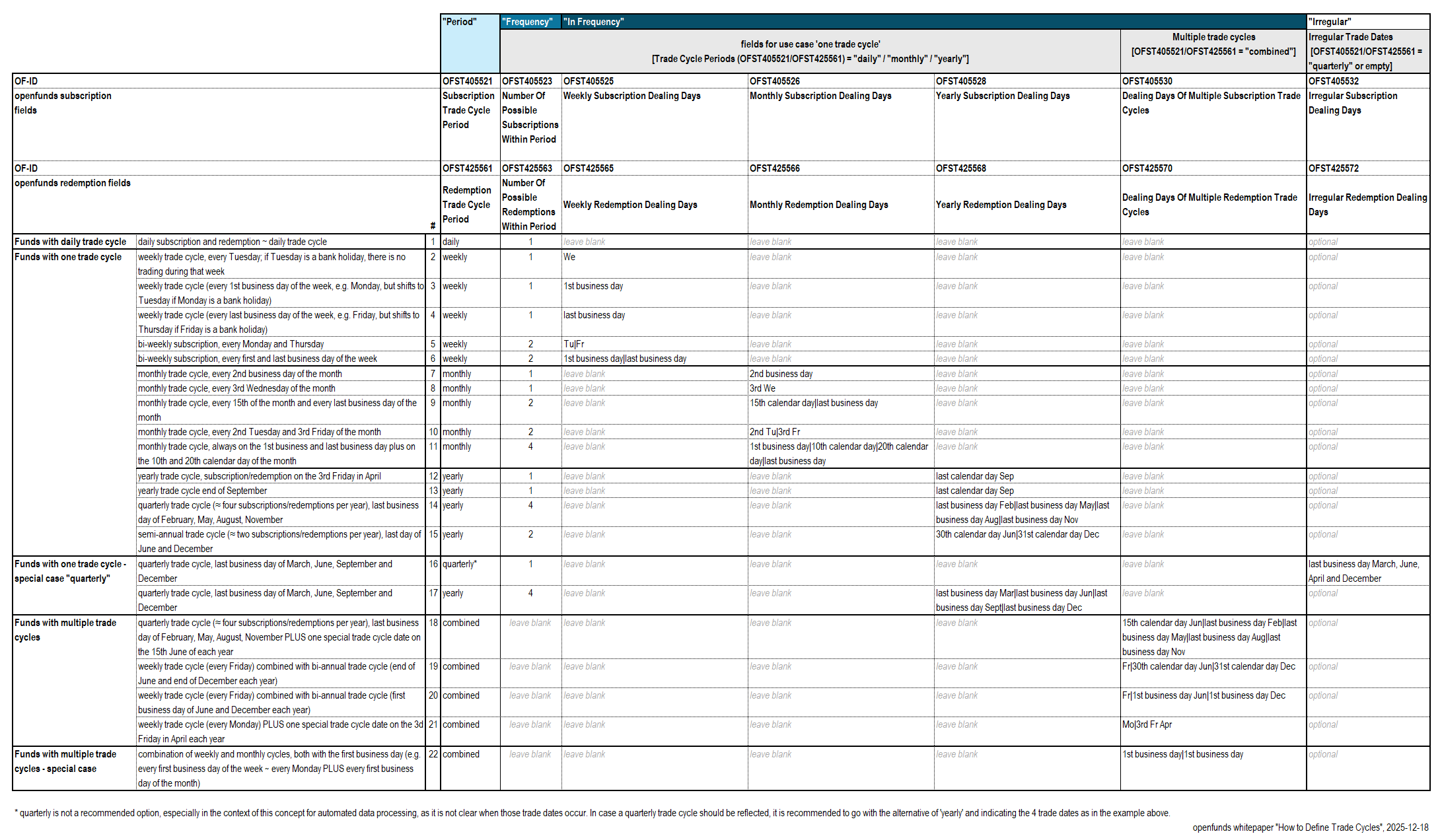
This scenario is reflected in #1 of the overview accessible here.
Funds with one trade cycle
First, define the recurring period, the OFST405521 “Subscription Trade Cycle Period” or the OFST425561 “Redemption Trade Cycle Period”. Possible values are “daily”, “weekly”, “monthly” or “yearly”.
[Note: for more information regarding the value “quarterly”, pls. refer to the section ‘Special case: quarterly trade cycle for subscriptions and redemptions’ further below.]
Secondly, specify how often you may buy and sell a fund during this period. (OFST405523 “Number Of Possible Subscriptions Within Period” or OFST425563 “Number Of Possible Redemptions Within Period”).
As a third step, please mention the specific dealing dates.
This last step is the most difficult one, as a yearly trade cycle is different from a monthly or a weekly one. That is the reason why openfunds lists six fields, three for subscriptions and three for redemptions to specify the dates as shown Table 1 above, within the rectangle “Specific Dealing Days”.
The main difference between weekly, monthly and yearly subscription is the number of terms. In this white paper we distinguish between three terms a), b), and c), with:
- Term a) being a number [1, 2, 3, …]
- Term b) being a day [business day, Mo, Tu, …], and
- Term c) being a month [Jan, Feb, Mar, …].
All scenarios explained in this whitepaper can be expressed with a combination of these three terms, whereas for certain scenarios, only some combinations are valid, whereas in others, the combination of all three terms is required for meaningful information.
Weekly trade cycle for subscriptions and redemptions
OFST405525 Weekly Subscription Dealing Days
OFST425565 Weekly Redemption Dealing Days
Possible values:
Weekly trade cycles are defined by Term b), i.e. a day (and only one or several days).
Term b):
[“1st business day”] [“last business day”] [“Su”] [“Mo”] [“Tu”] [“We”] [“Th”] [“Fr”] [“Sa”]
You should not combine 1st or last business day with weekdays, i.e. “Mo”, “Tu”, etc., however you may combine more than one weekday by listing them separated with a pipe “|“ (ASCII 124), e.g. “Tu|Th”.
Using “1st business day” (of week) shifts Mondays one day further, i.e. to Tuesday in case Monday is a bank holiday. This is not the case if you select “Mo”. The same is true for the difference between “last business day” and “Fr”. In this case, however, the “last business day” is Thursday in case Friday is a bank holiday.
Examples:
- “We”
- “Tu|Fr”
- “1st business day|last business day” (but not: “1st business day|Mo”)
These examples are reflected in the overview, #2 to #6.
Monthly trade cycle for subscriptions and redemptions
OFST405526 Monthly Subscription Dealing Days
OFST425566 Monthly Redemption Dealing Days
Possible values:
Monthly trade cycles consist of two terms, Term a) and Term b), i.e. a number and a day.
Term a):
[“1st”] [“2nd”] [“3rd”] [“4th”] [“5th”] … [“31st”] [“last”]
Term b):
[“business day”] [“calendar day”] [“Su”] [“Mo”] [“Tu”] [“We”] [“Th”] [“Fr”] [“Sa”].
With the values from Term a) (= number) and Term b) (= day), it is possible to combine several business or calendar days, e.g. “1st business day|15th calendar day|last business day”, meaning three different dates within a month. Please note that a date always consists of a number [Term a)] and a day [Term b)] and that there must be a pipe “|“ (ASCII 124) between different dates.
Examples:
- “15th calendar day|last business day”
- “1st business day|10th calendar day|20th calendar day|last business day”
- “2nd Tu|3rd Fr”
These examples are reflected in the overview, #7 to #11.
Yearly trade cycle for subscriptions and redemptions
OFST405528 Yearly Subscription Dealing Days
OFST425568 Yearly Redemption Dealing Days
Possible values:
Yearly trade cycles consist of three terms, Term a), Term b) and Term c), i.e. a number, a day and a month.
Term a):
[“1st”] [“2nd”] [“3rd”] [“4th”] [“5th”] … [“31st”] [“last”]
Term b):
[“calendar day”] [“business day”] [“Su”] [“Mo”] [“Tu”] [“We”] [“Th”] [“Fr”] [“Sa”]
Term c):
[“Jan”], [“Feb”], [“Mar”], [“Apr”], [“May”], [“Jun”], [“Jul”], [“Aug”], [“Sep”], [“Oct”], [“Nov”], [“Dec”]
The construction of annual dates is very similar to the one for monthly dates, but yearly dates consist of three parts, namely number [Term a)], days [Term b)] and months [Term c)]. Like monthly dates, you may list more than one yearly date by just adding new ones separated by a pipe “|“ (ASCII 124).
Examples:
- “last business day Feb|last business day May|last business day Aug|last business day Nov”
- “30th calendar day Jun|31st calendar day Dec”
- “3rd Fr Apr”
These examples are reflected in the overview, #12 to #15.
Special case: quarterly trade cycle for subscriptions and redemptions
OFST405521 Subscription Trade Cycle Period
OFST425561 Redemption Trade Cycle Period
Due to several requests, openfunds has added the option “quarterly” with field version 1.31 as an additional possible value of OFST405521 “Subscription Trade Cycle Period” and OFST425561 “Redemption Trade Cycle Period”.
However, upon a closer look, one can see that the value “quarterly” does not fit properly into the concept and can only be used in combination with a free text in OFST405532 “Irregular Subscription Dealing Days” or OFST425572 “ Irregular Redemption Dealing Days” (see Table 2 below). Instead, openfunds recommends using a period of “yearly”, combined with the frequency of “4” (four times a year) and the ‘in frequency’ to indicate the exact dates of the quarterly subscription/redemption dates (e.g. last day of March, June, September, December). This information is very precise, reflects exactly the same information as ‘quarterly’ would do and is standardized and machine readable.
“Quarterly” can still be used in those cases where the isolated fact that there is a regular, quarterly subscription and/or redemption trade cycle is sufficient or where standardized, machine-readable information is not required.
Some examples are reflected below and in the overview, #16 and #17.
| OFST405521 Subscription Trade Cycle Period | OFST405523 Number Of Possible Subscriptions Within Period | OFST405528 Yearly Subscription Dealing Days | OFST405532 Irregular Subscription Dealing Days | Comment | |
| 1 | quarterly | 1 | [leave blank] | last business day March, June, April and December | not recommended to use if more specific information than ‘quarterly’ should be transmitted in a machine-readable format |
| 2 | yearly | 4 | last business day Mar| last business day Jun| last business day Sep| last business day Dec | recommendation |
Table 2: illustrative example to reflect a quarterly trade cycle for subscriptions and openfunds’ recommendation. Note that redemptions follow the exact same principle.
Funds with multiple trade cycles
OFST405530 Dealing Days Of Multiple Subscription Trade Cycles
OFST425570 Dealing Days Of Multiple Redemption Trade Cycles
There are funds that have not only one cycle, but two or more belonging to different periods like the above mentioned ‘each Wednesday plus every last business day of the month’ (weekly plus monthly period).
In order to handle this rather complex series of dates, openfunds has defined two fields, i.e. “Specific Dealing Days for Multiple Trade Cycles” (see Table 1). These two fields, one for subscriptions (OFST405530 “Dealing Days Of Multiple Subscription Trade Cycles”) and the other one for redemptions (OFST425570 “Dealing Days Of Multiple Redemption Trade Cycles”), are again a combination of Term a), Term b) and Term c), but give even more flexibility to combine the different trade dates.
openfunds recommends populating them the same way as shown in the previous examples, separating each trade cycle with a pipe “|” (ASCII 124) in order to allow an automated data processing even for these types of complex trade cycles.
Possible values: Depending on the period (weekly, monthly, yearly) please use the same values as described in “Funds with one trade cycle”. To separate different cycles, just separate them with a pipe “|” (ASCII 124).
Examples:
- “15th calendar day Jun|last business day Feb|last business day May|last business day Aug|last business day Nov”
- “Fr|30th calendar day Jun|31st calendar day Dec”
- “Mo|3rd Fr Apr”
These examples are reflected in the overview, #18 to #21.
Special Case:
In case there are weekly and monthly cycles both with the first business day, the fields OFST405521 “Subscription Trade Cycle Period” / OFST425561 “Redemption Trade Cycle Period” should be filled with the value “combined” and OFST405530 “Dealing Days Of Multiple Subscription Trade Cycles” / OFST425570 “Dealing Days Of Multiple Redemption Trade Cycles” with the value “1st business day | 1st business day”.
Example special case:
- “1st business day|1st business day”: This combination stands for first business day of the week and first business day of the month.
This example is reflected in the overview, #22.
Automated data processing for multiple trade cycles:
Especially for multiple trade cycles the following rules can help to identify the period:
- Yearly period: the only period that mentions a month like [“Jan”], [“Feb”], etc.
- Monthly period: the only period that mentions “calendar” (day) or “business” (day) without a month. Also, a weekday like [“Su”], [“Mo”], [“Tu”], etc. cannot stand for itself, but has always a number like “1st”, “2nd” or “last” in front of it.
- Weekly period: the only period that mentions a weekday like [“Su”], [“Mo”], etc. without a number before it.
Document Information
| Title: | Trade Cycles |
| Language: | English |
| Confidentiality: | Public |
| Authors: | openfunds, Michael Partin, Birgit Partin |
Revision History
| Version | Date | Status | Notice |
|---|---|---|---|
| 1.4 | 2025-12-18 | Final | General review, addition of overview and clarification of “quarterly” use case. |
| 1.3 | 2018-07-18 | Final | Added fields for irregular dealing days and adjusted the trade cycle graphics. |
| 1.2 | 2018-06-27 | Final | Added example for special case for multiple trade cycles: 1st business day of the week and 1st business day of the month. |
| 1.1 | 2017-10-16 | Final | Corrections of wrongly mentioned values of OFST40525 (“business days” (correct) instead of “working days” (wrong)). |
| 1.0 | 2017-09-14 | Draft | First Version. |
If you wish to read or download this white paper as PDF, please click here.